50 Philosophical Writing Prompts for Kids: Questions That Inspire Deep Thinking and Wonder
Children are natural philosophers.
Long before they learn formal definitions, children ask some of life’s biggest questions:
Why are we here?
How do we know what is true?
What makes someone a good person?
Can people change?
What makes me who I am?
These questions are the beginning of philosophical thinking.
Philosophical writing prompts for kids encourage children to explore ideas, explain their reasoning, imagine possibilities, and develop their own understanding of the world. Unlike traditional writing assignments that often focus on finding one correct answer, philosophical prompts invite curiosity, reflection, creativity, and thoughtful discussion.
Wonder Prompts Collection journal prompts help children slow down, notice the world around them, and practice the skills that support lifelong learning: asking questions, considering different perspectives, making connections, and expressing ideas clearly.
Whether you are a homeschool parent, classroom teacher, or educator looking for meaningful writing activities, philosophical journal prompts provide a powerful way to combine writing practice with critical thinking.
What Are Philosophical Writing Prompts for Kids?
Philosophical writing prompts are open-ended questions that encourage children to think deeply about concepts such as truth, identity, fairness, purpose, knowledge, kindness, responsibility, and meaning.
Instead of asking children to simply recall information, philosophical prompts ask them to:
- explain their reasoning
- consider multiple viewpoints
- explore “what if” possibilities
- reflect on their experiences
- connect ideas together
- develop confidence in their own thinking
Philosophy for children is not about memorizing difficult theories. It is about learning how to wonder, question, reason, and communicate.
Why Teach Philosophy Through Writing?
Writing gives children a place to organize their thoughts and discover what they believe.
When children write about philosophical questions, they practice:
✅ Critical Thinking
Children learn to examine ideas instead of simply accepting them.
They begin asking:
- How do I know?
- Why do I think this?
- Could there be another answer?
✅ Communication Skills
Philosophical writing helps children explain complex ideas in their own words.
✅ Creativity
Many philosophical questions have no single answer, allowing children to imagine new possibilities.
✅ Self-Awareness
Children explore their values, beliefs, emotions, and experiences.
✅ Independent Reasoning
Instead of looking for the “right” answer, children learn to build thoughtful answers.
How WonderPrompts Helps Children Develop Philosophical Thinking
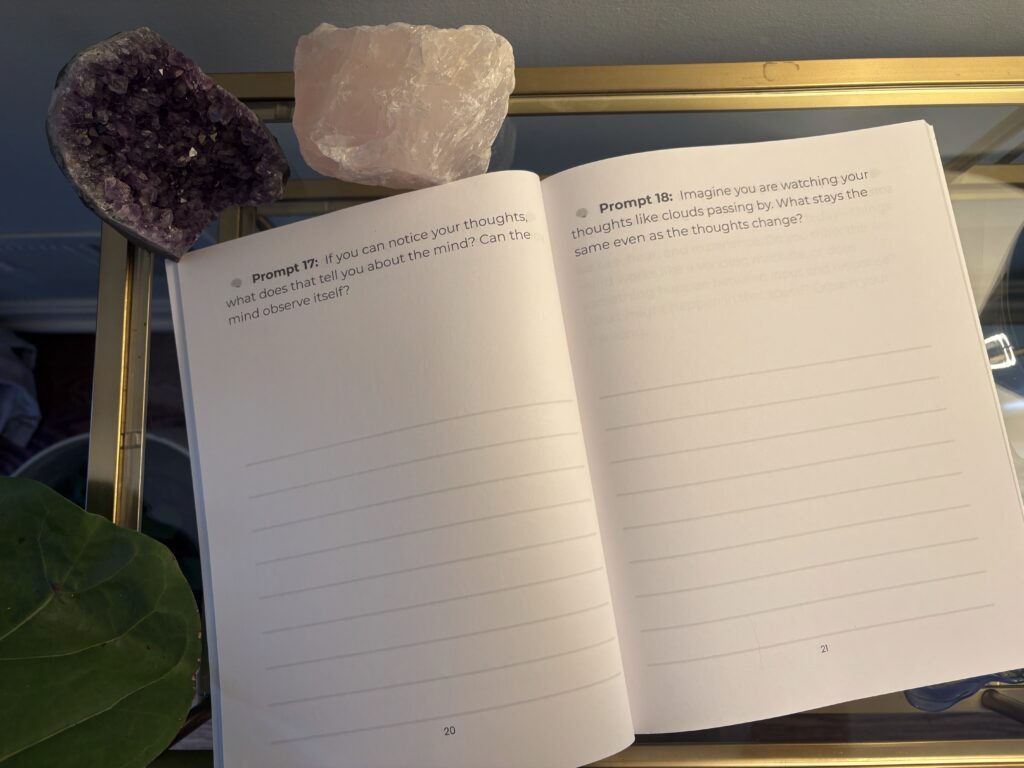
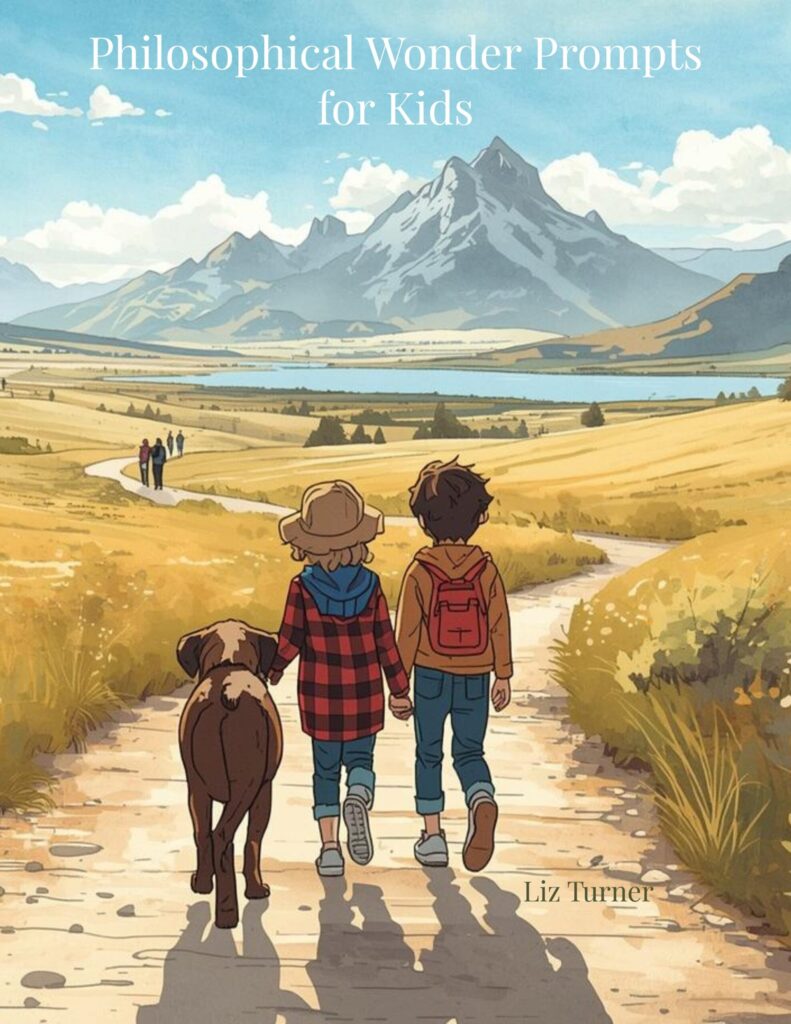
Philosophical WonderPrompts is a guided journal designed to inspire deep thinking and creativity without pressure.
Across one semester (thirteen weeks), children explore age-appropriate questions drawn from major areas of philosophy, including:
- Epistemology — truth, belief, and knowledge
- Philosophy of mind — thoughts, awareness, and inner life
- Personal identity — who we are over time
- Ethics and virtue — kindness, fairness, and character
- Free will and responsibility — choices and consequences
- Metaphysics — patterns, order, and meaning
- The transcendentals — beauty, truth, goodness, and unity
- Teleology — purpose, work, and contribution
- Formation — who we are becoming over time
Each week centers around one “big question,” and each day approaches that question through a thoughtful rhythm:
- Wondering
- Reflecting
- Reasoning
- Imagining
- Deciding
- Explaining
- Integrating ideas through expression or reflection
This gentle structure helps children develop a sustainable habit of thoughtful writing.
50 Philosophical Writing Prompts for Kids
And now… for the moment you’ve been waiting for! Here are 50 philosophical writing prompts to get you started. These prompts are designed for elementary and middle school students. They can be used for:
- homeschool writing curriculum
- classroom journals
- morning writing activities
- language arts enrichment
- family discussions
- independent writing practice
Truth, Knowledge, and Belief Prompts
1. How do you know when something is true?
What clues help you decide whether something is real, accurate, or trustworthy?
2. Can two people believe different things and both be right?
Explain a situation where different perspectives might both have value.
3. Is everything we believe a fact?
What is the difference between a belief, an opinion, and a fact?
4. Can we know everything?
Are there some things humans may never fully understand?
5. Is imagination a kind of knowledge?
Can imagining something help us discover something new?
6. How do we decide who or what to trust?
What makes a person, source, or idea trustworthy?
The Mind and Inner World Prompts
7. What makes your thoughts your own?
Where do ideas come from?
8. Are thoughts real even though we cannot see them?
Explain what makes something real.
9. What makes you aware that you are you?
How do you know you have your own inner world?
10. Would you still be yourself if you had different memories?
What parts of you make you who you are?
11. Can animals think and feel?
How are animal minds similar to and different from human minds?
12. Is imagination as important as knowledge?
Why or why not?
Identity and Becoming Prompts
13. What makes you the same person you were when you were younger?
What changes and what stays the same?
14. Can someone completely change and still be themselves?
Explain your reasoning.
15. Are you defined more by what you do or who you are?
Which matters more?
16. What makes every person unique?
Is uniqueness about appearance, personality, experiences, or something else?
17. If you could meet yourself from ten years in the future, what would you ask?
What would you want to know?
18. Who are you becoming?
Describe the kind of person you hope to grow into.
Ethics and Virtue Prompts
19. What makes someone a good person?
Is goodness about actions, intentions, character, or something else?
20. Is being kind always the right choice?
Can kindness ever be complicated?
21. Is honesty always the best choice?
Are there situations where telling the truth is difficult?
22. Can something be allowed but still wrong?
Explain the difference between rules and morality.
23. Why do people help others?
What motivates kindness?
24. Is forgiveness a strength?
Why or why not?
Fairness, Responsibility, and Choices
25. What does it mean to be responsible?
What responsibilities do children have?
26. Are we responsible for our choices if we make mistakes?
Explain your thinking.
27. Should everyone always get the same thing?
What is the difference between equality and fairness?
28. Can one person make a difference in the world?
How?
29. Should people always follow rules?
When might questioning a rule be important?
30. What makes a good leader?
What qualities should leaders have?
Free Will and Decision-Making Prompts
31. Do you always choose your actions freely?
What influences your decisions?
32. How much control do we have over who we become?
Which parts of life can we change?
33. Can someone make a wrong choice for a good reason?
Explain.
34. Are our choices shaped by our experiences?
How does your past influence you?
35. What does it mean to be free?
Is freedom only about doing what you want?
Meaning, Purpose, and Contribution Prompts
36. Why do people create things?
Why do humans make art, inventions, stories, and discoveries?
37. Does everyone have a purpose?
What might purpose mean?
38. What makes a life meaningful?
What things give life value?
39. How can one person contribute to the world?
What gifts or talents can people share?
40. Is success about achievement or something else?
How would you define success?
Beauty, Truth, Goodness, and Wonder Prompts
41. What makes something beautiful?
Can something be beautiful to one person and not another?
42. Why are humans drawn to beauty?
Why do we create music, art, and stories?
43. Is beauty only about appearance?
What other kinds of beauty exist?
44. Can something be true but not beautiful?
Explain.
45. Can something be good even if it is difficult?
Give an example.
Big Wonder Questions
46. Why do humans ask questions?
What would happen if nobody wondered?
47. What is one mystery you hope humans solve someday?
Why does it matter?
48. If you could teach the world one important lesson, what would it be?
Explain why.
49. What question do you think everyone should ask themselves?
Why?
50. What do you wonder about most?
Write about a question you hope to keep exploring.
How to Use Philosophical Writing Prompts in Homeschool and Classrooms
Philosophical prompts are flexible and work well across many learning environments.
Homeschool Ideas
Use prompts as:
- morning basket activities
- language arts assignments
- family discussion starters
- independent journal work
- writing enrichment
A single prompt can become:
- a short paragraph
- a longer essay
- a drawing
- a conversation
- a research project
Classroom Ideas
Teachers can use philosophical writing prompts for:
- bell ringers
- journal warm-ups
- Socratic discussions
- writing centers
- gifted education enrichment
- social-emotional learning activities
Because there is no single correct response, students of different reading and writing abilities can participate meaningfully.
Looking for More Creative Writing Prompts?
Philosophical thinking and creativity naturally work together. After exploring big questions, children can continue building imagination and storytelling skills with:
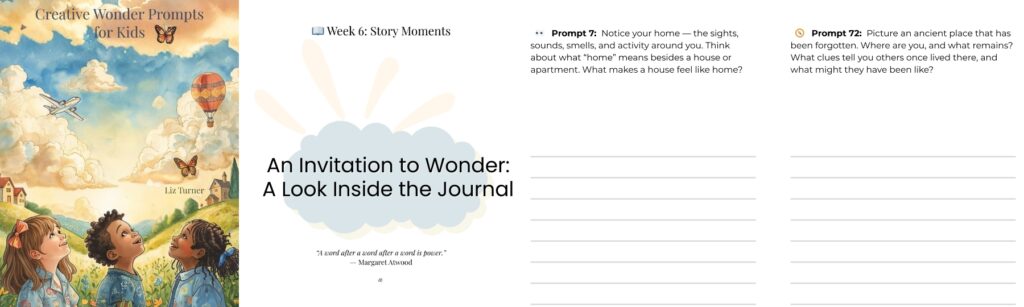
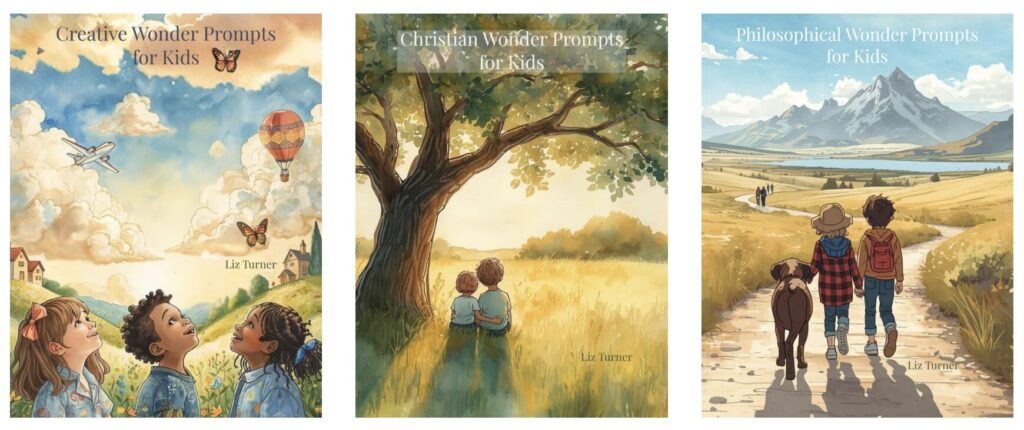
Creative WonderPrompts for Kids — a guided writing journal filled with open-ended creative writing prompts designed to inspire storytelling, observation, imagination, and expressive confidence.
Explore the companion article:
50 Creative Writing Prompts for Kids That Inspire Imagination and Storytellinghttps://www.wonderpromptscollection.com/creative-writing-prompts-for-kids/
Explore Philosophical WonderPrompts for Kids
If you are looking for a meaningful philosophy journal for kids, homeschool enrichment activity, or classroom writing resource, Philosophical WonderPrompts for Kids provide a gentle framework for helping children explore life’s biggest questions.
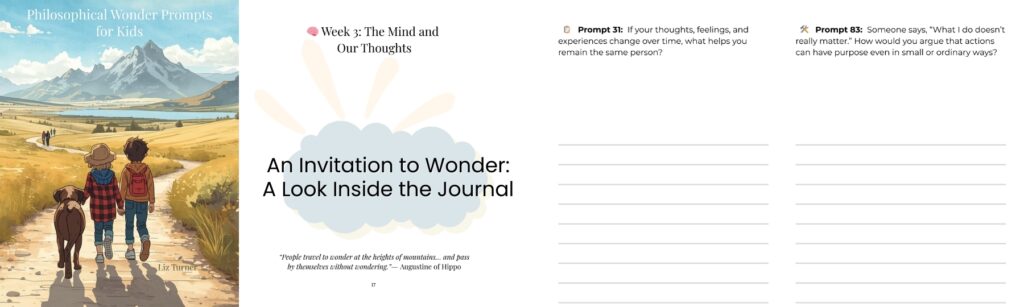
Designed for curious learners, the guided journal encourages children to think deeply while developing:
✓ critical thinking skills
✓ writing confidence
✓ independent reasoning
✓ reflection habits
✓ creativity and imagination
Get your Philosophical WonderPrompts journal for $12.99:
Explore the full Wonder Prompts Collection:
Frequently Asked Questions About Philosophical Writing Prompts for Kids
What age are philosophical writing prompts appropriate for?
Philosophical writing prompts can be adapted for elementary students, middle school students, and even older learners. Younger children may respond through drawings or short answers, while older students can write deeper reflections and essays.
Can elementary students learn philosophy?
Yes. Philosophy begins with curiosity. Children naturally ask questions about fairness, identity, truth, and meaning. Age-appropriate philosophy helps them practice reasoning and thoughtful discussion.
Are philosophical writing prompts good for homeschool?
Yes. Philosophical journals are especially useful for homeschool families because they combine writing practice, critical thinking, discussion, and character development.
How are philosophical prompts different from regular journal prompts?
Traditional journal prompts often ask children to describe experiences. Philosophical prompts ask children to examine ideas, explain reasoning, and explore deeper questions.
What skills do philosophical writing prompts develop?
They support critical thinking, communication, creativity, self-awareness, reasoning, and confidence expressing ideas.
Discover the entire Wonder Prompts Collection and explore more children’s writing prompt samples, homeschool writing curriculum, and daily open-and-go daily writing activities for kids here.
From the author: Hi there! I’m Liz. I’m a homeschool mom with a college-level background in philosophy-neuroscience-psychology as well as elementary and middle school education and counseling. I created Philosophical Wonder Prompts when I was hoping to find an introduction to classical philosophy for my late-elementary and middle school children. I hoped to combine an introduction to philosophical reasoning and thinking with an open-and-go writing prompt journal format so that my homeschoolers could take their journals with them for daily 10-15 minute writing. This is a great tool when waiting for appointments, as a start to your school day, or for any family prioritizing philosophy and writing skills in their children. I hope you enjoy the Wonder Prompts Collection!

Leave a Reply